First edition · 2026 · ISBN 979-8-9978915-0-3 (PDF)

Access Before Approval

When Standard Options Fall Short: Legal Access Pathways in Regenerative Medicine — for Patients and Physicians

The book does not evaluate or endorse any product, clinic, or physician. It maps pathways that already exist so patients and physicians can navigate them with greater clarity, discipline, and care.

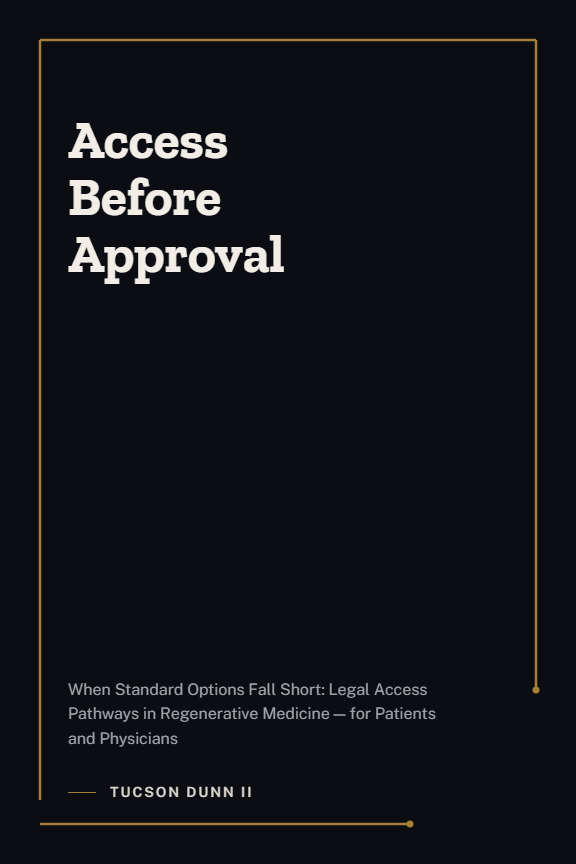
Cover of Access Before Approval by Tucson Dunn II

How to use this book

Built to be opened to the page that answers the question in front of you.

Chapters 1–17 carry the full decision framework and are the only section meant to be read start to finish. Everything after it applies that framework by state, by pathway strength, and by condition.

Patients and families

  • Arriving with a diagnosis: start with Pathways by Condition, then the Part II Guide and Appendix for any state it names.
  • Arriving with a state already in mind: start with that state’s Access Guide, then confirm against the Appendix.
  • Comparing states: start with the Cross-State Pathway Summary.

Physicians

  • Deciding whether to participate: read the full Part II Guide, then the Appendix for sourcing, documentation, and advertising rules.
  • Confirming a specific statutory requirement: go to that state’s Appendix entry.
  • Fielding a condition-specific request: start in Pathways by Condition, then route back to Part II and the Appendix.

Contents

The map of the book.

How to Use This Book

Separate entry points for patients, families, and physicians.

p. 8

Chapters 1–17

The only section meant to be read start to finish.

p. 10

Part II — State Access Guides

Sixteen alphabetical maps, Arizona through Wyoming.

p. 75

Cross-State Pathway Summary

Formal-pathway comparison, then states without a statute.

p. 155

Pathways by Condition

Start with a diagnosis, not a state.

p. 159

Appendix — All 50 States

Seven operative statutes in full; condensed entries for the rest.

p. 188

Glossary

How this book uses the technical terms.

p. 228

The Language of the Access Pathway

The conversational vocabulary from first call to follow-up.

p. 235

References

Sources behind the statutes and findings.

p. 240

Index

Lookup by topic, statute, and state.

p. 245

About the Author

Tucson Dunn II.

p. 254

Chapters 1–17

Why these pathways exist, how to evaluate an option honestly, how to prepare, how to work with a physician, how to read documentation, and how to live with the uncertainty that remains.

  1. 01Why Access Matters Now10
  2. 02The Origins of Parallel Access12
  3. 03Pathways to Emerging Treatments16
  4. 04Evaluating the Option21
  5. 05Preparing to Proceed25
  6. 06Pursuing the Pathway28
  7. 07Interpreting Outcomes Over Time31
  8. 08Living with Uncertainty34
  9. 09The Evolving Landscape of Access37
  10. 10A Closing Perspective40
  11. 11Matching the Patient to the Pathway42
  12. 12The Documentation & Quality Filter48
  13. 13Working with the Physician54
  14. 14Practical Barriers Beyond the Law62
  15. 15Follow-Up, Monitoring, and Interpreting Outcomes66
  16. 16Looking Ahead: The Evolving Landscape of Access70
  17. 17Moving Forward73

Part II · page 75

Sixteen State Access Guides.

Alphabetical maps for Arizona through Wyoming. Seven states have an operative regenerative-medicine statute: Florida, Georgia, Montana, North Carolina, Tennessee, Texas, and Wyoming. A formal pathway is not automatically the easiest real-world route.

Florida

Formal pathway

SB 1768 / Chapter 2025-185

Part II · page 89

Structured pathway for qualifying viable stem-cell products from accredited, FDA-registered facilities. Formal uses are limited to orthopedics, pain management, and wound healing. Exosomes sit outside the statute. Residual FDA overlay remains.

Residual FDA authority over unapproved biologics applies in every state. A statute is a map, not a waiver.

Cross-State Pathway Summary

Page 155. A high-level comparison of what each formal pathway actually covers — product types, named conditions, and whether exosomes sit inside or outside the statute — then states without a dedicated regenerative law.

Appendix — all 50 states

Page 188. Quick-reference table for every state, full statutory reconstruction for the seven operative statutes, and condensed entries for the remaining forty-three plus the District of Columbia.

Pathways by condition · page 159

Patients and physicians rarely begin with a state. They begin with a diagnosis.

Each entry answers the evidence question first, then the pathway question. A fast legal route is never presented as a substitute for supporting evidence. Autism and migraine are omitted on purpose — evidence against, and no dedicated human trial, respectively.

  • Chronic kidney disease

    The book’s fullest worked example, through Chapter 15.

  • Traumatic brain injury

    Florida’s statute excludes TBI by scope. Evidence remains preclinical.

  • Orthopedic and musculoskeletal

    The most common commercial use; Florida’s three named indications include it.

  • Alzheimer’s disease

    Pathway and evidence are treated as separate questions.

  • Parkinson’s disease

    State maps applied to a progressive neurologic diagnosis.

  • COPD

    Speed of access is never presented as a substitute for evidence.

  • Wound healing and psoriasis

    Florida names wound healing; other states do not.

  • Epilepsy and peripheral nerve

    A shorter shared note; same legal questions as related entries.

  • Anti-aging / longevity / skin

    A different legal picture, addressed on its own terms.

Tucson Dunn II, author of Access Before Approval

About the author · page 254

Tucson Dunn II

More than two decades in senior hospital and health-system executive roles across the United States, the United Kingdom, Europe, the Middle East, and Asia — including Boston University Medical Center, University of Chicago Hospitals, Dana-Farber Cancer Institute, and major private hospital groups in Scotland, Indonesia, the Philippines, Thailand, Malaysia, China, the UAE, Poland, and Vietnam.

In that work he repeatedly encountered a practical barrier: even when a therapy had national regulatory approval, hospital Therapeutic Committees could delay or block access for months or years. Physician-owned clinics often provided faster, more direct pathways.

In 2018 he moved from the provider side into biotech manufacturing, focusing on stem cells and extracellular particles (exosomes). In Europe he contributed to early national ATMP authorizations under Hospital Exemption frameworks. That dual view — hospital executive and manufacturer — is the reason the book stays practical.

Copies

Request the book.

First edition, 2026. PDF, $29. Forthcoming October 2026. ISBN 979-8-9978915-0-3. Write to author@accessbeforeapproval.com.

  • 17 chapters of decision framework
  • 16 State Access Guides, plus a 50-state appendix
  • Pathways by condition, glossary, and references

Dedicated to Nataliia, Matvii, and Michelle.

Requests go to author@accessbeforeapproval.com. We will not share your details. This is not an order form and does not create a medical relationship.